Tag Archives: academic writing

Update to IPEd’s indicative costs for editing academic work

The Institute of Professional Editors, known as IPEd, has updated its guidance for potential clients on the costs of editing a range of academic work, first released in 2021. The indicative costs as of March 2024 and notes on the range of factors which may affect costs are available here.

The indicative costs complement the fair hourly pay rates for self-employed editors released by IPEd and available here.

I am pleased to be a member of IPEd’s Standing Committee on Academic Editing which developed and updated the indicative costs, and also a member of IPEd’s Pay and Conditions Standing Committee (formerly the Pay Rates Working Party) which developed and updated the fair hourly pay rates.

Many clients who have not used a professional editor before may not be aware of the likely costs. These indicative costs allow clients, particularly research students, to budget and prepare well ahead of time, regardless of which editor they use.

There are many sources of funding which can contribute to cover the costs of professional editing, and clients should be aware of all the sources available before approaching an editor. These sources can include funds within the school, Faculty or university, national and international scholarships and grants, supervisor research funds, project funds or external sources.

The IPEd costs are indicative only, and editors will always want to see the full work to be edited before providing a quote.

Other useful IPEd resources:

Working with self-employed editors: A guide for clients

Guidelines for editing research theses

To work with an accredited editor focusing on academic editing, please contact me at rhdaniels@bigpond.com
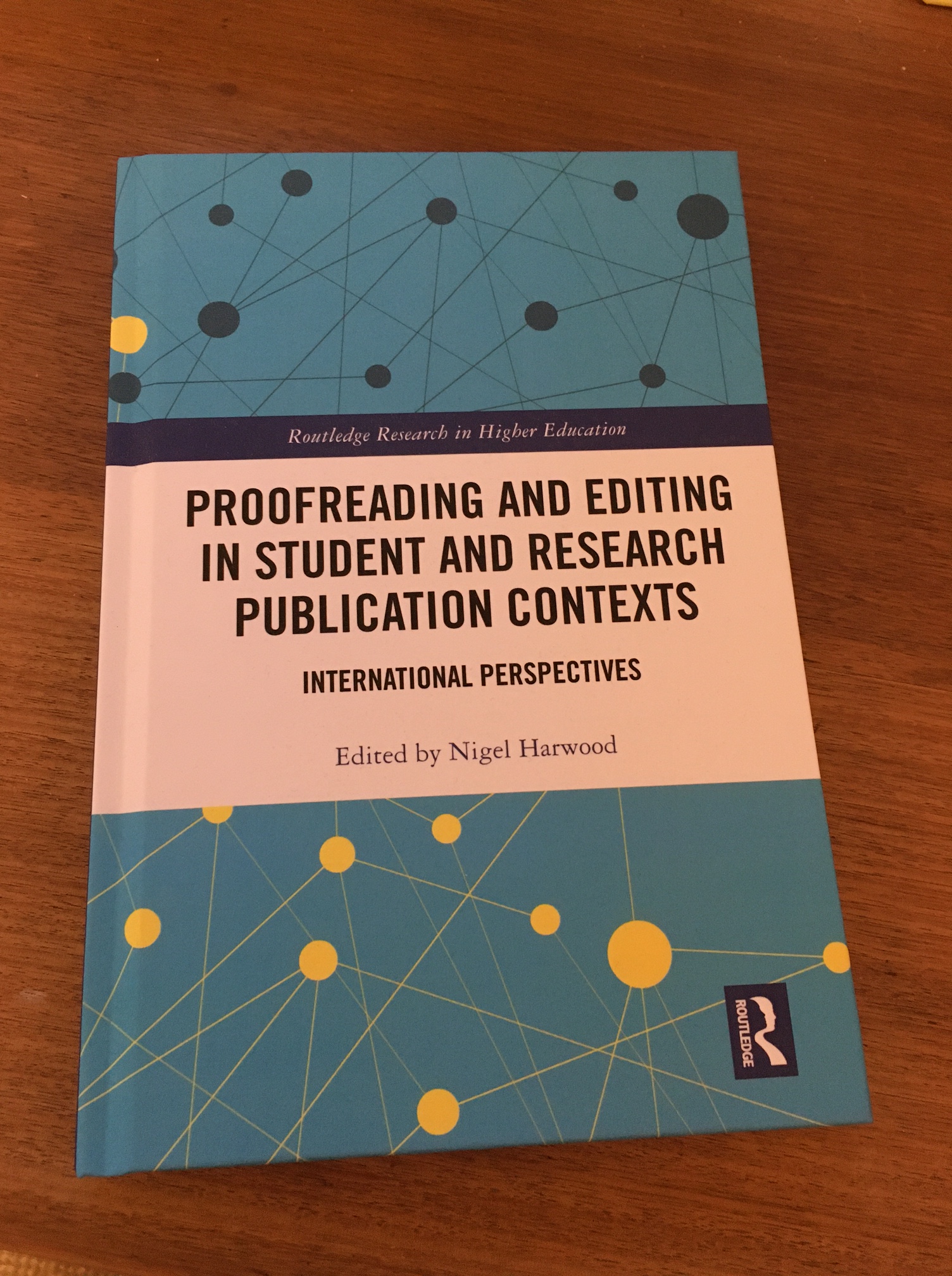
My co-authored chapters in new academic editing book

I am pleased to advise that a book I have co-authored two chapters in, based on my academic editing work, is now available.

The book is Proofreading and Editing in Student and Research Publication Contexts: International Perspectives, edited by Professor Nigel Harwood of the University of Sheffield. It explores proofreading and editing from a variety of research and practitioner-led perspectives to describe and debate roles and policies in the student and research publication context.

My co-author Charlotte Cottier AE and I have been members of IPEd’s Standing Committee on Academic Editing since 2017, noting the chapters reflect our personal views and our experience as self-employed academic editors.

Our two chapters are:

Chapter 4. “Please can you proofread my thesis?” Exploring initial student enquiries for thesis editing in Australia by Charlotte Cottier and Rhonda Daniels

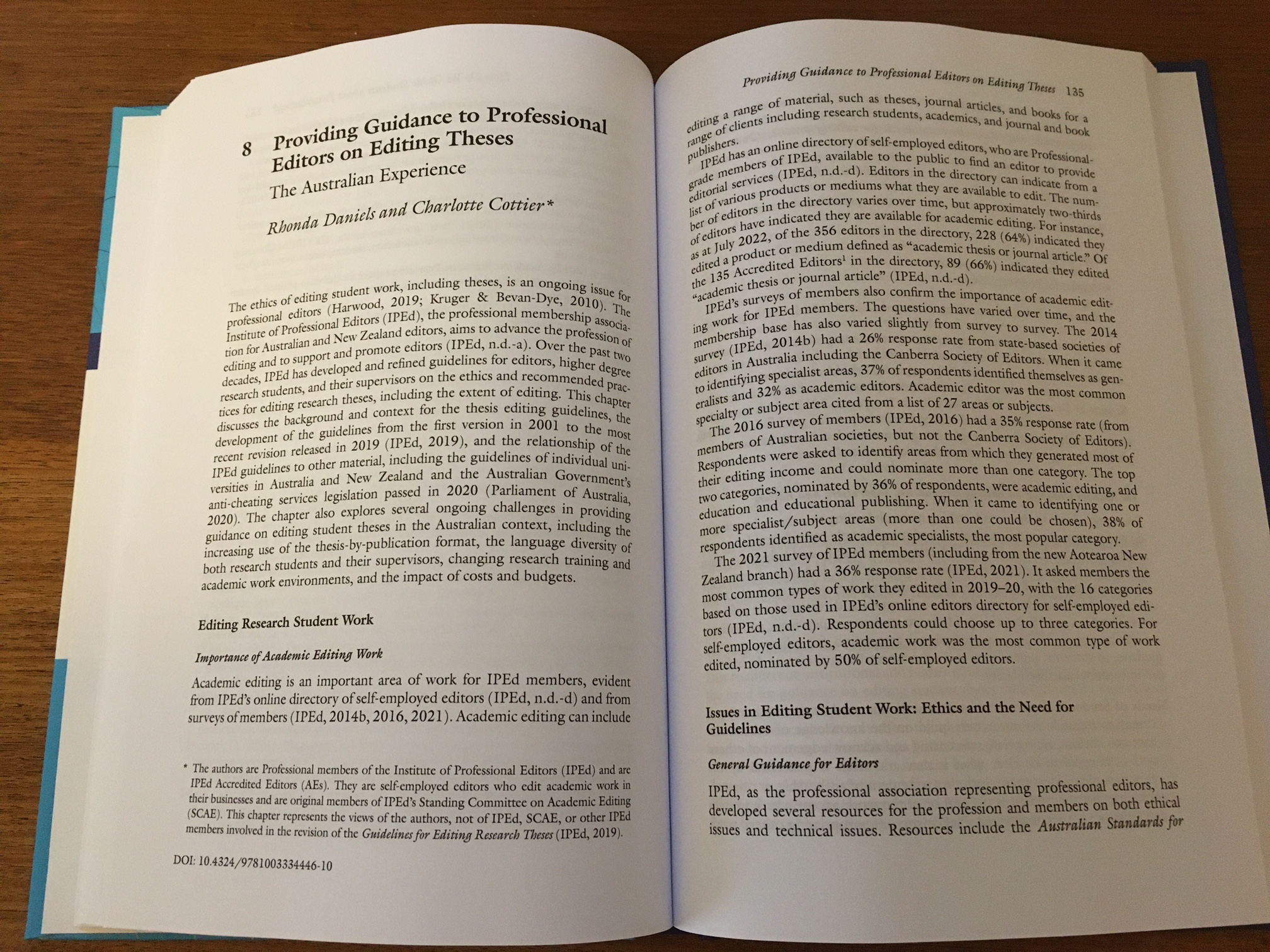
Chapter 8. Providing guidance to professional editors on editing theses: The Australian experience by Rhonda Daniels and Charlotte Cottier

The first page of Chapter 4 titled Please can you proofread my thesis?
The first 2 pages of Chapter 8 titled Providing guidance to professional editors on editing theses

The book was released on 19 March 2024. See the Routledge website here for the table of contents and purchase options:

Discount code to buy the book

As well as the hard copy, an ebook is available at a reduced price. Use this code for a 20% discount: AFLY01

Keeping up with AI tools

In Chapter 8, written in late 2022, a section titled Changing Research Training and Academic Environments refers to increasing use of artificial intelligence in writing. Little did we know of the impact of generative AI tools such as ChatGPT that became publicly available in 2023. As noted in my recent blog, professionals in many fields, including editors, are wondering and worrying about the impact of generative AI and ChatGPT on their working lives. Universities are still developing policy for students.

To work with an accredited editor focused on academic editing, please contact me at rhdaniels@bigpond.com

Celebrating 10 years of Right with Rhonda – Part 2

Welcome to part 2 of my blog celebrating 10 years since I started my business Right with Rhonda in late 2013. Read part 1 here.

1. Reflections on my clients

      I have enjoyed working with a diversity of clients over many years, including students and academics, and public sector clients. I have supported clients from editing their PhD thesis, to then editing their job applications, editing their journal articles, editing the theses of students they supervise, editing their students’ journal articles, editing research grant applications, and then editing their promotion applications. Some clients are well on the path from PhD student to Professor. Many of my clients are at top universities in Australia. Read my blog on university rankings and editing here.

      2. Reflections on my work

      It has been very satisfying to edit public reports and research on important issues in gender equality, health, education, transport, and diversity and inclusion. Some work has been publicly available, and some work is published in journals. I am maintaining confidentiality by not mentioning specific reports here, but I am named and acknowledged on some.

      Most of my work is broadly in the social sciences, but sometimes there is something a little different – like archaeology, veterinary science or research in countries I am less familiar with like Mongolia. I enjoy contributing in my areas of knowledge including economic geography, urban planning and transport, using my experience as a published researcher.

      Read my blog on getting published in Nature here.

      3. Reflections on the changing nature of editing work

      Over 10 years of business, I feel there has been a greater acceptance of a more relaxed approach to strict grammar and style rules. This is partly due to the delay in updating the Australian Government’s Style Manual, the emergence of other Australian style guides, the increase in short-form and informal communication such as texts and Twitter, and the variety of “Englishes” around the world. As always, the focus should be on clear communication for the purpose and audience.

      Over 10 years, I have definitely seen better use of reference management software from students, but referencing still needs checking.

      However, not every one takes advantage of all the useful style, structure and formatting features in Word when working on a long document. This is my number 1 tip for students – learn how to use Word early on. It saves time later on.

      With research becoming increasingly complex, clear presentation is essential. It is so competitive to publish in the top academic journals that professional copy editing on all submissions, from the first to the final, is essential to avoid distracting errors and typos and get past gatekeeping journal editors. Some journals even require authors to organise and certify the copy editing. I have had an increase in clients in China, usually through Australian co-authors, as Chinese researchers also seek to publish in the top English language international journals.

      4. Looking ahead

      Looking ahead, I’m sure there will be more changes in editing. Even with the development of AI tools such as ChatGPT, there will always be a need for a careful and thoughtful professional editor with real-world commonsense.

      As I noted in my blog in 2020, Celebrating 100 editing blogs and 7 years of Right with Rhonda, my blogs are based on issues which arise in my day to day work as a self-employed academic editor and as a professional member of the Institute of Professional Editors. Thanks to all my clients over the last 10 years for providing such interesting material to edit and making me think.

      Read all my blogs here.

      Contact me

      To work with an accredited editor who has been successful for over 10 years striving for clear communication, please contact me at rhdaniels@bigpond.com
      English as the global language for research

      English is increasingly recognised as the global language of research, but this does pose problems for both individual researchers and the broader scientific community.

      Ten years ago, in an article in The Conversation in 2013 on English as a world language Stewart Riddle noted: “There are more non-native speakers of English than native speakers; nearly four out of five English-speaking interactions happen between non-native speakers of English; most research is shared in English-language journals; English is the number one language used on internet sites; and most literature is published in English or translated from English into other languages”.

      Recently in March 2023, global academic publisher Elsevier commented here on English as the lasting language of publication with an examination of the rise of English as lingua franca of academic publishing.

      On a similar theme, in July 2023, Tatsuya Amano from the University of Queensland summarised research in an article in The Conversation: “Our collective emphasis on English places a significant burden on scientists who speak a different first language.” “The scientific community urgently needs to address language barriers so that future generations of non-native English speakers can proudly contribute to science.”

      Amano explained the problem: “The use of English in the internationalisation of research and higher education comes at a cost to local knowledge and languages, as academics in … other parts of the world compete with scholars from the UK and USA to publish in high-ranking English-language research journals.”

      The dominance of English does impose burdens on individual authors who are not as comfortable writing and communicating in English, and limits the scientific community in general. With journals and conferences receiving so many submissions, sometimes the quality of the English contributes to decisions to reject.

      In Australia, with its internationally recognised university sector, there are many academics and research students from English-as-an-another-language backgrounds. Academic editors provide important services for both. Academic editors can be part of the research team, working with individual authors before submission or working with journals.

      Read my recent blog on university rankings and academic editing: links for success in Sydney here.

      Recognising the issue of language is one step in addressing it. Providing professional assistance can be part of the solution.

      To work with an accredited editor who knows academic standards, please contact me at rhdaniels@bigpond.com

      University rankings and academic editing: links for success in Sydney

      Two universities I am closely associated with have just been ranked equal 19th in the prestigious 2024 QS World University Rankings: UNSW Sydney and the University of Sydney. As a graduate and donor of both universities, I received the exciting news directly from both. I have a Bachelor of Science in economic geography (Hons) and a Master of Policy Studies from UNSW, and a PhD in management from the University of Sydney. As a self-employed academic editor for 10 years at Right with Rhonda, I edit work for both universities in diverse areas including business and management, built environment, engineering, and public health.

      The rankings included three new categories this year: sustainability, employment outcomes and international research network. The increasing international profile of both universities in attracting students and producing quality research is important. Of course, when institutions go down in rankings, there is always criticism of the ranking methods.

      The increase in rankings of both universities to equal 19th globally is a credit to many, many people. I am pleased to have made a small professional contribution to helping students and academics apply for research funding, communicate their research effectively and publish their research in top journals and conferences.

      As UNSW Sydney noted, Sydney is a very attractive place for education and research with 10% of the top 20 universities globally located in the city.

      Read more from both proud universities here: UNSW and University of Sydney.

      Read some of my past blogs on success in academic publishing:

      To work with an accredited editor with academic publishing experience who strives for clear communication, please contact me at rhdaniels@bigpond.com

      Futureproofing editing: 11th IPEd editors conference 2023

      The IPEd conference held online in May 2023 had the theme of futureproofing the profession of editing – very topical for editors and their clients in the age of AI and ChatGPT. Are editors redundant? No. Reassuringly, keynote speaker Martin Delahunty explained that ChatGPT still requires human curation and checking answers. It requires human intervention behind the scenes, and in use. We still need critical thinking, and editors are excellent at critical thinking, checking, and exercising judgement. For instance, AI can make up convincing references that do not in fact exist.

      Clearly AI is very useful. It is already being used and will continue to bring changes. The landscape is changing very quickly and policies are being developed in different fields. In education, schools and universities are developing policies on student use. In academic publishing, some journals have developed policies that AI cannot be a paper author, but authors need to acknowledge and cite AI if it is used.

      The Plain English Foundation has produced a report on editors and ChatGPT. Get the report here.

      The conference also provided an update on IPEd activities, including the work of the Pay and Conditions Standing Committee of which I am a member.

      This is the fourth IPEd conference I have attended. See my blogs on previous conferences here:

      Brisbane 2017: “An excellence of editors” – advancing the profession conference

      Melbourne 2019: Beyond the page – words from the IPEd national conference May 2019

      Hobart 2021: Editing on the edges: the IPEd editors conference, June 2021

      As part of my own futureproofing, I look forward to viewing sessions I couldn’t attend in real time.

      To work with an accredited editor who strives for clear communication, please contact me at rhdaniels@bigpond.com

      Editors are always asking “Does that seem right?”

      After a data privacy breach by a major Australian telecomms company in September 2022, current and former customers need to be even more vigilant about emails, phone calls and other communications to prevent identity fraud and other scams.

      With increasing digital communications, spam and scams are always evolving. In day to day life, we all need to be aware and ask “does that seem right?”.

      I have written two previous blogs on the issue of spam and editing:

      In whatever field they edit, editors constantly ask themselves when reading and editing work – “does it sound right?” or “does that seem right?” Editors may be uncertain about a fact, a detail, apparent inconsistencies, or even tone. If they are not sure, editors can check a range of other sources, or raise a query with the author. Even when checking sources, editors also need to be aware of the credibility of sources, and keep asking “does that seem right?”.

      Editors are finely attuned to nuances and inconsistencies, and are able to question and check diverse elements. It doesn’t mean editors are foolproof, but they are very detail oriented and analytical. At the same time, they have a focus on the big picture and whether every element in a work comes together to make sense to readers.

      To improve your digital safety, approach all communications like an editor, and ask yourself “does that seem right?”.

      To work with an accredited editor who asks the right questions on academic and research work, please contact me at rhdaniels@bigpond.com

      Finding an editor and getting a reply when there are labour shortages

      After two years of the COVID-19 pandemic, there are labour shortages in all sectors of the Australian workforce. To help find an editor when you want one, it is important to consider an inquiry from the editor’s perspective.

      Editors receive many inquiries from potential clients. Often the inquiry is about the availability of the editor and the cost of editing. Unfortunately, many inquiries do not provide sufficient information in the initial request for an editor to answer.

      On availability, it is important to advise when the material may be ready for editing, such as right now, a definite time in the future, or an unknown time in the distant future. It is also important to advise of any timeframes or deadlines for returning the edited work. Editors may work at different paces, or be balancing other work, and this affects availability to edit any specific piece of work at a specific time.

      On cost, professional editors prefer to see the full material to be edited before providing a quote with a cost. The editing work required on material can vary so much, I never provide a cost based on the total word count alone. I always need to see the full file.

      My website here provide useful information on what affects pricing and what information to provide when seeking academic editing.

      See my other blogs on working with an editor:

      To find a professional editor, consider IPEd’s online directory of editors here. You can search over 350 editors by different criteria including type of editing, subject area and Accredited Editor status. Many entries have additional information or a website to help find the best editor for the job.

      To work with an accredited editor on research-related material, please contact me at rhdaniels@bigpond.com

      Editing Australia’s Census – thanks to everyone for the high quality

      The Australian Bureau of Statistics’ Census of Population and Housing is a huge undertaking of great significance to Australian public data and decision making. The release of the first data in July 2022 from our most recent 5-yearly Census in August 2021 is significant. There was much media attention including discussion of questions and wording, suggestions for future data collection, and even discussion of appropriate description of the “average” Australian. It is great to see so much interest in such an important source of information.

      Apart from diligently filling in my form online last August, I was not involved in the 2021 Census at all. However, I have used Census data in my previous research life and public sector jobs in urban and transport planning, and now as a volunteer for the Institute of Professional Editors’ Pay Rates Working Party. I edit academic and research material for clients which uses Australian Bureau of Statistics data from the Census and other sources including its spatial classifications. From all my experience, I know how important the data is, and even had my letter supporting the Census published in The Sydney Morning Herald when Census funding was under threat.

      As an editor striving for high quality communication in research, I send a special thank you to everyone involved in the high quality of the Australian Census, from the forms to all the summary reports and data releases. The Australian Bureau of Statistics sets a high standard for all and shows the value of a high quality approach to data collection, analysis and presentation.

      To work with an IPEd accredited editor on research-related material, please contact me at rhdaniels@bigpond.com

      Structure tip: Move from the general to the specific

      With complex material to present in a long research document, it can be difficult to get the structure right, particularly in the introduction.

      A good technique to organise material is to move from the general to the specific. This tip works for the whole document and for the introduction and for other sections.

      In the introduction or first section, write enough to introduce the broad topic and put your work in context. Then go into detail. Diving straight into the detail may lose some readers. Similarly, too much general background that is well known to readers may leave them wondering if there is anything new and whether it is worth reading on.

      Establish the purpose of your writing, what you are contributing, and why it is worth readers continuing to read on. Be aware of technical terms or jargon in the introduction. Are these terms helpful or offputting? How well known are they?

      Reverse this structure technique at the other end of the document. When discussing results or drawing conclusions, move from the specific back to the general. Summarise your work, then broaden it out to generalisations. There may be limitations and caveats to note when moving from the specific back to the general.

      More tips for structure:

      • Consider the audience and their level of familiarity with the material when deciding where to start in the general context.
      • Use the title, headings and subheadings to set the scene and prepare the reader for the content in the whole work and each section, and the context.
      • Use a top-down approach to structure by developing the headings first, then the subheadings and use content in dot points under each heading as a guide for your writing.

      See related blogs:

      For advice on editing and writing, please contact me on rhdaniels@bigpond.com