Author Archives: Rhonda Daniels

University rankings and academic editing: links for success in Sydney

Two universities I am closely associated with have just been ranked equal 19th in the prestigious 2024 QS World University Rankings: UNSW Sydney and the University of Sydney. As a graduate and donor of both universities, I received the exciting news directly from both. I have a Bachelor of Science in economic geography (Hons) and a Master of Policy Studies from UNSW, and a PhD in management from the University of Sydney. As a self-employed academic editor for 10 years at Right with Rhonda, I edit work for both universities in diverse areas including business and management, built environment, engineering, and public health.

The rankings included three new categories this year: sustainability, employment outcomes and international research network. The increasing international profile of both universities in attracting students and producing quality research is important. Of course, when institutions go down in rankings, there is always criticism of the ranking methods.

The increase in rankings of both universities to equal 19th globally is a credit to many, many people. I am pleased to have made a small professional contribution to helping students and academics apply for research funding, communicate their research effectively and publish their research in top journals and conferences.

As UNSW Sydney noted, Sydney is a very attractive place for education and research with 10% of the top 20 universities globally located in the city.

Read more from both proud universities here: UNSW and University of Sydney.

Read some of my past blogs on success in academic publishing:

To work with an accredited editor with academic publishing experience who strives for clear communication, please contact me at rhdaniels@bigpond.com
Futureproofing editing: 11th IPEd editors conference 2023

The IPEd conference held online in May 2023 had the theme of futureproofing the profession of editing – very topical for editors and their clients in the age of AI and ChatGPT. Are editors redundant? No. Reassuringly, keynote speaker Martin Delahunty explained that ChatGPT still requires human curation and checking answers. It requires human intervention behind the scenes, and in use. We still need critical thinking, and editors are excellent at critical thinking, checking, and exercising judgement. For instance, AI can make up convincing references that do not in fact exist.

Clearly AI is very useful. It is already being used and will continue to bring changes. The landscape is changing very quickly and policies are being developed in different fields. In education, schools and universities are developing policies on student use. In academic publishing, some journals have developed policies that AI cannot be a paper author, but authors need to acknowledge and cite AI if it is used.

The Plain English Foundation has produced a report on editors and ChatGPT. Get the report here.

The conference also provided an update on IPEd activities, including the work of the Pay and Conditions Standing Committee of which I am a member.

This is the fourth IPEd conference I have attended. See my blogs on previous conferences here:

Brisbane 2017: “An excellence of editors” – advancing the profession conference

Melbourne 2019: Beyond the page – words from the IPEd national conference May 2019

Hobart 2021: Editing on the edges: the IPEd editors conference, June 2021

As part of my own futureproofing, I look forward to viewing sessions I couldn’t attend in real time.

To work with an accredited editor who strives for clear communication, please contact me at rhdaniels@bigpond.com

Everywhen: Indigenous history and language

A new book combines my interests in Indigenous culture, Australian history and language. Everywhen: Australia and the Language of Deep History is edited by Ann McGrath, Jakelin Troy and Laura Rademaker and published by University of Nebraska Press, 2023.

It is difficult to describe the complex focus of the book and the book title is not necessarily going to be clear to potential readers. The publisher blurb says “Everywhen is a groundbreaking collection about diverse ways of conceiving, knowing, and narrating time and deep history. Looking beyond the linear documentary past of Western or academic history, this collection asks how knowledge systems of Australia’s Aboriginals and Torres Strait Islanders can broaden our understandings of the past and of historical practice.”

I like this comment about Indigenous languages: “language both as a means of knowing and transmitting the past across generations and as source material for historical investigation”.

This is a diverse collection of chapters, which will attract different interest depending on readers’ perspectives. The editors themselves note in their lengthy and excellent introduction that “the contributors do not all agree with each other”, and “that juxtaposing Indigenous and non-Indigenous perspectives… will inevitably introduce some sharp contrasts of style”.

I particularly enjoyed Chapter 10 on analysis of 13 different versions of a Wik story of early Indigenous encounters with the Dutch in northern Queensland, and Chapter 12 on the living heritage of the Dharawal Country people in southern Sydney, where the trail of Gymea lilies marks a songline from the forest country to the coast to celebrate the whale. With the notes and bibliography for each chapter, it is not as long (and daunting) as it may first look.

The Everywhen book and my recent experiences documented in my blog Cultural safety in editing continue my interest in learning more about Aboriginal culture and supporting culturally diverse perspectives, both personally and professionally, building on the Diploma in Aboriginal Studies I completed in 2008. The free app on Dharawal Language and Culture by Gujaga Foundation in La Perouse provides information on the language of the Dharawal people of southern Sydney where I live.

See my other blogs on recent books:

Writing on the Job

More than Words: The Making of the Macquarie Dictionary

Look – It’s Your Book

To work with an accredited editor who strives for clear communication, please contact me at rhdaniels@bigpond.com

Look – It’s Your Book! by Anna Featherstone

This hefty guide by an Australian author has it all for people who want to publish their own book in Australia. It has an exclamation mark because having your own book is exciting. It is subtitled: Write, publish and promote your non-fiction book: A self-publishing guide for Australian writers. It is a great effort to pull all the relevant information together. There are five main sections. As well as covering the basics of writing and editing and publishing, it also covers those neglected topics of distribution, marketing and leveraging.

There are lots of subheadings to find content easily. The extra tips and insights from various experts scattered throughout are useful, although sometimes it is confusing who was saying what (the author or the interviewed expert). Who doesn’t know and love Kim McCosker, best-selling author of the 4-ingredients recipe books.

Anna thanks all the people involved at the back of the book, showing it really does take a team to get a book published, whether it is a traditional publisher or self-publishing. Anna has published her own books and learnt from the experience.

The book is published by Anna’s imprint CapeAble Publishing, 2022.

See https://annafeatherstone.com/product/look-its-your-book-a-self-publishing-guide-for-australian-writers/

Very practical and highly recommended. There’s also an accompanying workbook.

See my recent blogs on other books:

Writing on the Job

More Than Words: The Making of the Macquarie Dictionary

To work with an accredited editor who strives for clear communication, please contact me at rhdaniels@bigpond.com

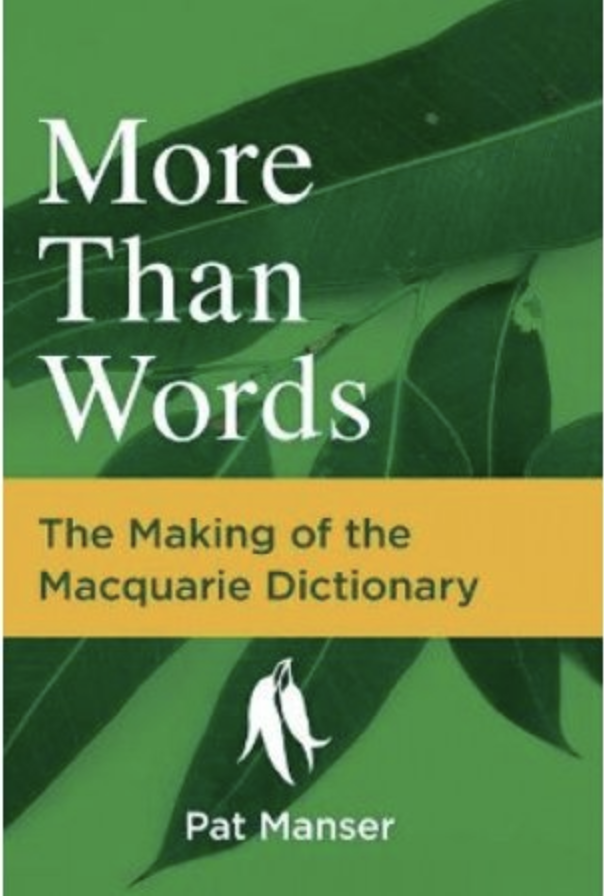
More than Words: The Making of the Macquarie Dictionary by Pat Manser

English and History teacher Pat Manser started working on the Macquarie Dictionary in 1973 and is well placed to tell the story of how it all came together and has continued to grow.

Part One is a good introduction to a new kind of dictionary, and how it was put together.

Part Two is the road to publication. Launched on 21 September 1981, the dictionary was described as the first comprehensive documentation of Australian English.

Part Three is the ongoing evolution. After the launch, the team began the process of establishing a dictionary in every market at every price point, which included 23 spin-off editions in 10 years. Appendix A has a long list of Macquarie publications. I had no idea there were so many! One I do have is the Macquarie Atlas of Indigenous Australia (2005). The Macquarie Dictionary Eighth Edition in two volumes was released in 2020.

The book also contains photos of the many people involved over the years.

I found More than Words in my local library, but check your favourite book supplier. It is published by Macquarie Dictionary, Pan Macmillan Australia, 2021.

For more on this theme, see books by Sue Butler AO, Editor of the Macquarie Dictionary: Rebel without a Clause, The Aitch Factor and The Dinkum Dictionary.

See www.macquariedictionary.com.au

To work with an accredited editor who strives for clear communication, please contact me at rhdaniels@bigpond.com

Writing on the job – a simple guide by Martha Coven

When a book on writing follows its own advice, and is short, simple and easy to read, it’s worth reading. Martha B. Coven has written a book on writing in the workplace titled Writing on the Job: Best practices for communicating in the digital age.

I particularly liked the chapter on editing. It starts “Edit everything. Even a one-paragraph email”. Couldn’t agree more. Martha provides some interesting advice on how much time to spend on editing your own work and recommends “a good rule of thumb is to spend two-thirds of your time writing, and one-third editing”.

She also advises that, in the digital age, screens can make everything look tidy and professional. Editing requires a careful, slower read than quickly scrolling on a screen. Her number 1 tip to overcome this problem is what I also recommend for long documents: print a hard copy, and read that.

I also support “Think like a critic. Become your own worst critic.”

Grammar is clearly important, but Martha recognises that “much of what we call grammar is a matter of stylistic preference”. For instance, she is in favour of using “they” to refer to one person. In general, I agree and I edit to ensure clear communication.

I found Writing on the Job in my local library, but check your favourite book supplier. It is published by Princeton University Press, 2022.

See my other reviews of books related to editing:

Is a subversive copy editor right for you?

Edit is a four-letter word

New Style Manual now online

The Australian Editing Handbook, 3rd edition

To work with an accredited editor who strives for clear communication, please contact me at rhdaniels@bigpond.com

The visibility and value of editing

Two items this week highlight the value of editing. First, an academic client contacted me to say she had been awarded a highly competitive ARC Discovery Project grant for 2023. She was very grateful for the help I provided in editing her grant application in economics. While not all high quality applications can be successful, job and grant applications are some of the best examples of the value of editing and return on investment.

As I noted in my recent blog on cultural safety in editing here, this is the second time in recent months that an ARC Discovery Project application I have edited has been successful. The two projects were in very different fields.

Second, Alice Grundy from the Australian National University wrote in The Conversation on 28 November 2022 on the visibility of editors here. It is obvious and true that it is very hard to appreciate the value of editing if it is never mentioned or credited. In my many years as a reader, I have noticed that in the preliminary pages of a book, the book cover designer is often named, but not the people who worked on editing the book and shaping it into the final product. It is not always possible to credit editors, and some editors may prefer not be credited on some work, but we can do better.

Several aspects of editing contribute to it being under-recognised and under-valued: it is mostly done by women, it is creative work, it can be done alone and at home, it is invisible, and it is piece work. Better recognition of editors is central to better pay and conditions for editing, and to increase the diversity of editors and published material.

I have been working on this issue for several years. At the members forum following the AGM of the Institute of Professional Editors in November 2022, I spoke briefly about the work of the Pay and Conditions Standing Committee to increase pay rates in the Book Industry Award for employee editors in the publishing industry. This builds on my other volunteer work for the Institute of Professional Editors including indicative costs of academic editing here.

See my related previous blogs:

To work with an accredited editor who provides value to clients, please contact me at rhdaniels@bigpond.com

Consistency is core for editors and readers

There are many definitions of editing. At its heart, editing is about clear communication and making it easy for the reader. An important way to achieve that is through consistency. Consistency is part of making it easy for the reader by avoiding distractions.

Consistency applies to all aspects of a document from the micro to the macro scale. It includes decisions about the basics of spelling, grammar, punctuation, capitalisation, hyphenation, abbreviations and acronyms, numbers, symbols and common terms. It can refer to sentence and paragraph length and structure which affect the general reading level of a document. It can also refer to the look of a document, from formatting and the heading hierarchy to tables and figures. For documents with sources, consistent use of references both in the text and in the reference list is important and can contribute to the credibility of research work.

Editors and writers make choices about style all the time to meet the needs of their audience and the message. Editing is about decision making, and editors make and implement decisions efficiently and accurately. While there is not always right and wrong in editing, it is important to be consistent within a document.

To ensure consistency and clear communication, there are style manuals and tools for different audiences and purposes. The Australian government’s Style Manual, now available online, has been complemented by other manuals such as the online Australian manual of style. There are guides for the many different styles of referencing, some with minor variations in punctuation. Not everyone will agree there is one accepted right decision. However, using a style guide or style sheet can help ensure consistency throughout a document and over time.

See my blogs on related aspects of consistency:

To work with an accredited editor who strives for consistency and quality, please contact me at rhdaniels@bigpond.com

Editors are always asking “Does that seem right?”

After a data privacy breach by a major Australian telecomms company in September 2022, current and former customers need to be even more vigilant about emails, phone calls and other communications to prevent identity fraud and other scams.

With increasing digital communications, spam and scams are always evolving. In day to day life, we all need to be aware and ask “does that seem right?”.

I have written two previous blogs on the issue of spam and editing:

In whatever field they edit, editors constantly ask themselves when reading and editing work – “does it sound right?” or “does that seem right?” Editors may be uncertain about a fact, a detail, apparent inconsistencies, or even tone. If they are not sure, editors can check a range of other sources, or raise a query with the author. Even when checking sources, editors also need to be aware of the credibility of sources, and keep asking “does that seem right?”.

Editors are finely attuned to nuances and inconsistencies, and are able to question and check diverse elements. It doesn’t mean editors are foolproof, but they are very detail oriented and analytical. At the same time, they have a focus on the big picture and whether every element in a work comes together to make sense to readers.

To improve your digital safety, approach all communications like an editor, and ask yourself “does that seem right?”.

To work with an accredited editor who asks the right questions on academic and research work, please contact me at rhdaniels@bigpond.com

Finding an editor and getting a reply when there are labour shortages

After two years of the COVID-19 pandemic, there are labour shortages in all sectors of the Australian workforce. To help find an editor when you want one, it is important to consider an inquiry from the editor’s perspective.

Editors receive many inquiries from potential clients. Often the inquiry is about the availability of the editor and the cost of editing. Unfortunately, many inquiries do not provide sufficient information in the initial request for an editor to answer.

On availability, it is important to advise when the material may be ready for editing, such as right now, a definite time in the future, or an unknown time in the distant future. It is also important to advise of any timeframes or deadlines for returning the edited work. Editors may work at different paces, or be balancing other work, and this affects availability to edit any specific piece of work at a specific time.

On cost, professional editors prefer to see the full material to be edited before providing a quote with a cost. The editing work required on material can vary so much, I never provide a cost based on the total word count alone. I always need to see the full file.

My website here provide useful information on what affects pricing and what information to provide when seeking academic editing.

See my other blogs on working with an editor:

To find a professional editor, consider IPEd’s online directory of editors here. You can search over 350 editors by different criteria including type of editing, subject area and Accredited Editor status. Many entries have additional information or a website to help find the best editor for the job.

To work with an accredited editor on research-related material, please contact me at rhdaniels@bigpond.com