Is writing your new year’s resolution?

This is the time of year when many people think about what they want to achieve over the next 12 months. For some people, that goal involves writing. It might be a fiction or non-fiction book, thesis, family history, memoir or other piece of writing. A large piece of writing can be daunting which makes it hard to even get started.

Here are some tips.

  • Think about the overall structure.
  • Break the task into smaller pieces of writing.
  • Set deadlines for each piece of writing.
  • Learn how to use features of Word for long documents.
  • Remember the tip: What I really want to say is…
  • Make a start and fix it up later.
  • Join a local writing group for support.

If you want to write, but don’t know what to write about, think about your passions and what interests you. It is always easy to write with passion.

An editor can help you at several stages of your writing, from the initial planning to the finishing touches. An editor can help structure and organise your writing at the beginning, and also copy edit your writing to ensure consistency and clear communication, whatever your audience and message.

For editing and writing inquiries, contact Right with Rhonda at rhdaniels@bigpond.com

Getting published in Nature journal

There is much competition to publish research in a leading journal. Congratulations to lead author Giles Hamm, doctoral student in archaeology at La Trobe University, for his recent success in publishing a paper in Nature.

The paper, titled Cultural innovation and megafauna interaction in the early settlement of arid Australia, was published on 2 November 2016 in Nature 539, 280-283. It reported archaeological research at Warratyi rock shelter in the Flinders Ranges.

I worked with Giles on several iterations of the paper including identifying the key findings, interpreting the journal guidelines, advising on the submission process, and editing the text, references and supplementary information.

Publishing in a top scientific journal can be a long process and many people have a say in the final paper including the co-authors (13 for this paper), the reviewers and Nature editorial staff. Don’t be surprised if the paper goes through many changes. Accept that not everyone involved (including the editor) will agree on every word as published.

Consider these tips

  • Read the journal guidelines and follow them.
  • Use feedback to improve the paper.
  • Be prepared for a long process.
  • Persevere.

Read the abstract for free and check full access options here.

What’s the purpose of grammar?

A recent Editors NSW workshop on grammar with presenter Elizabeth Manning Murphy DE was a reminder about the purpose of grammar. Grammar is the communication code we all share and it helps us communicate clearly in writing and in speech. It is just as important for new media such as emails and websites as the old media of printed letters. It improves understanding, ensures clarity and reduces confusion.

Formally teaching and learning grammar did go out of fashion for a time, so it is common for people to be unsure of the right uses of grammar or think something looks odd without being able to explain why.

Some grammar tips

  • Understand grammar conventions before breaking them for effective writing.
  • Be aware of the different parts of speech such as nouns, pronouns, verbs, adjectives, adverbs, prepositions and conjunctions.
  • Be aware of common mistakes and look out for them.
  • Find a grammar reference book that is useful for you.
  • Remember English is a living language and conventions change over time.

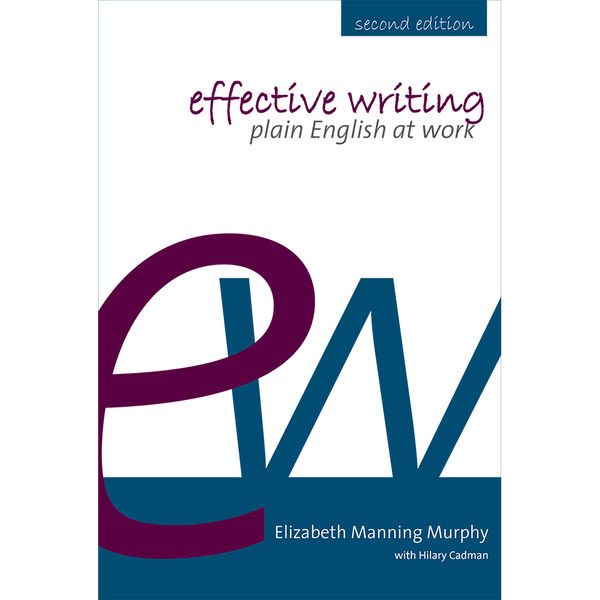
Elizabeth’s book Effective Writing: Plain English at Work is a great easy to read resource. It emphasises that grammar is the basis for plain English style which is recommended for government and business communication.

Effective writing: plain English at work by Elizabeth Manning Murphy

Effective writing: plain English at work by Elizabeth Manning Murphy

The Style Manual for Authors, Editors and Printers is a comprehensive resource on many aspects of writing and editing (see my blog here).

For editing queries, please contact me at rhdaniels@bigpond.com

Awesome abstracts for articles

An abstract is a summary of an article, while the longer Executive Summary has a similar role for reports. The abstract may be the most important part of your article. Most people will not read more than the abstract, so make it a useful summary. Don’t make your abstract an afterthought at the end of a very long process of research, writing and review.

Make your abstract awesome:

  • Keep to the specified word length.
  • Convey the importance of the topic.
  • Have a clear ‘takeaway” message about results.
  • Make every word count.
  • Define key terms and avoid abbreviations, acronyms and jargon.

As the abstract reflects your results, it should be written in either the present or past tense. Future tense is sometimes used for abstracts written to be accepted for conferences, before the content of the research is finalised.

What do you want readers to remember about your work? Make it easy for readers with an awesome abstract.

See our related blog on Short summaries take time.

For editing queries, please contact me at rhdaniels@bigpond.com

Rhonda Daniels is now an Accredited Editor

iped-logo

I am pleased to announce that I am now an Accredited Editor with the Institute of Professional Editors.

An Accredited Editor has demonstrated their professional competence and understanding of editing standards, skills and knowledge by passing the Institute of Professional Editors’ three-hour accreditation exam. The exam, administered by IPEd’s Accreditation Board, measures an editor’s competence against the benchmark of the Australian standards for editing practice.

Editors who pass the accreditation exam are certified by the IPEd Accreditation Board and can use the postnominal AE (for ‘accredited editor’). Accredited editors are listed here.

The accreditation scheme offers Australian editors a mechanism to demonstrate their competence and provides potential employers with confidence in the skills of the editors they hire.

For editing queries, please contact me at rhdaniels@bigpond.com

Is a subversive copy editor right for you?

The Subversive Copy Editor

The Subversive Copy Editor

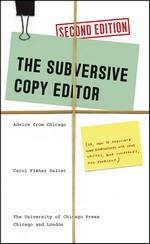
The Subversive Copy Editor, a 2016 book by Carol Fisher Saller, highlights the skills editors need for good working relationships with writers. Carol is the editor of The Chicago Manual of Style Online’s monthly Chicago Style Q&A, and has handled tens of thousands of writing and editing queries since 1997.

Her editing approach is ‘subversive’, firstly because it puts the reader above the writer as the ultimate boss of editors, and secondly because ‘to live a good life as a copy editor, a person must occasionally think outside the rules’. Of course, this is not really subversive. Experienced editors know when a style is just a style, and when to break rules.

Carol emphasises the need for editors to keep reading and keep up to date with language trends so they can ‘acquire the power of knowing when to break a rule in order to help writers achieve great writing’.

Other tips for both writers and editors to remember are:

  • do no harm
  • a work will never be edited the same way twice and it will never be considered perfect, no matter how many times it is edited.

So, yes, a subversive copy editor is probably right for you.

Note: I received a review copy of this book from University of Chicago Press through Editors NSW.

For editing queries, contact me at rhdaniels@bigpond.com
Know your audience and write for them

This week I came across a journal with a very specific title: The International Journal of the First Year in Higher Education. This title is very clear. It communicates what the journal is about, what content to expect and who the audience is, even without reading its blurb.

Just to confirm, the blurb at www.fyhejournal.com says the journal “focuses on research and practice about enhancing the experience of commencing students” and the journal’s audiences are “academic and professional staff involved in first year programs as well as senior managers with responsibility for first year policies and strategies”.

It is a good reminder to know your audience and write for them, which includes:

  • getting the title right
  • getting the content right
  • getting the structure right
  • getting the language right.

For more, see my blogs Write for your reader and audience and Are your headings helpful?

But wait. In August 2015, the journal was renamed to Student Success: A journal exploring the experiences of students in tertiary education to broaden the focus from First Year to a wider view of student engagement and success in tertiary education.

What do you think of the name change?

When to use brackets (or not)

The use of brackets can guide readers on the importance of information. Brackets, also known as parentheses, usually enclose less important material in a sentence such as acronyms, asides, comments, clarifications, dates, definitions, examples and extra information.

As readers are more likely to skip over text in brackets, I prefer to avoid brackets and use commas or long dashes, known as en rules, to separate information. This is consistent with trends to minimise punctuation and streamline the look of text.

Brackets can be round (like these) or square [like these]. The Australian Style Manual for Authors, Editors and Printers (Snooks & Co, 2002, p. 111) explains that square brackets are “primarily used in quoted material to signify editorial interpolations or insertions made by someone other than the author”.

In work using the author-date reference style, references in the text are put in brackets. But to emphasise a specific author, not just the content, put the author name in the text and just the year in brackets. Compare these examples:

  • Daniels (2016) suggests minimising the use of brackets.
  • Brackets enclose material that is not essential to the meaning of the sentence (Snooks & Co, 2002, p. 110).

For more on the relative importance of information in text, see my post on Footnotes – not a fan.

Check pagination as well as the text

Editing is more than just checking the text of a document. The pagination of the document, or how the material is laid out across the pages, should also be checked to ensure the document communicates clearly and effectively to readers.

Look out for these common pagination issues:

  • Keep a table on one page – do not split tables over pages
  • Refer to a table or figure in the text, before it appears in the document
  • Keep notes and captions with tables and figures and do not split over pages
  • Ensure headings do not appear at the bottom of a page
  • Ensure a single line of a paragraph is not left on its own at the top or bottom of a page
  • Use the “Insert page break” command to start a new page, instead of lots of “Returns”.

Editing of text is often done at 150% view size, but to check pagination, use whole page view to scroll through a long document. Even better, print the document as a final check. Be aware that different printer settings can affect pagination, so save in pdf format to stabilise the layout. Changes made at the last minute, even inserting a single word, can also change the pagination and layout of the document with flow on effects over several pages, so take care with these changes.

Top two mistakes in academic writing

The top two mistakes in academic writing I see when editing theses and journal articles are writers trying too hard and not meeting the requirements.

Mistake 1 – Trying too hard

Trying too hard describes a style of writing that tries to impress with complexity, rather than clarity. Impress with simplicity. As much as possible, use the simplest form of a word, delete filler and unnecessary words, keep sentence and paragraph length easy to read, minimise the use of acronyms and jargon, and provide the appropriate level of detail at the right place. Make it easy for the reader. See my other blog tips on writing to impress through simplicity.

Mistake 2 – Not meeting the requirements

As with all writing, academic writing is written for a particular audience for a particular purpose. It is important to know and meet the requirements of the style of writing, the audience and the publisher. Some of the requirements for a thesis might include total word length, original contribution, critical analysis, the structure and the reference style. The requirements for a journal article might include relevance to the aims of the journal, word length, footnotes (or not), and the number of tables or figures allowed.

Improve your academic writing by avoiding the top two mistakes. Keep it clear and simple, and know and meet the requirements.