Category Archives: thesis editing

Update to IPEd’s indicative costs for editing academic work

The Institute of Professional Editors, known as IPEd, has updated its guidance for potential clients on the costs of editing a range of academic work, first released in 2021. The indicative costs as of March 2024 and notes on the range of factors which may affect costs are available here.

The indicative costs complement the fair hourly pay rates for self-employed editors released by IPEd and available here.

I am pleased to be a member of IPEd’s Standing Committee on Academic Editing which developed and updated the indicative costs, and also a member of IPEd’s Pay and Conditions Standing Committee (formerly the Pay Rates Working Party) which developed and updated the fair hourly pay rates.

Many clients who have not used a professional editor before may not be aware of the likely costs. These indicative costs allow clients, particularly research students, to budget and prepare well ahead of time, regardless of which editor they use.

There are many sources of funding which can contribute to cover the costs of professional editing, and clients should be aware of all the sources available before approaching an editor. These sources can include funds within the school, Faculty or university, national and international scholarships and grants, supervisor research funds, project funds or external sources.

The IPEd costs are indicative only, and editors will always want to see the full work to be edited before providing a quote.

Other useful IPEd resources:

Working with self-employed editors: A guide for clients

Guidelines for editing research theses

To work with an accredited editor focusing on academic editing, please contact me at rhdaniels@bigpond.com
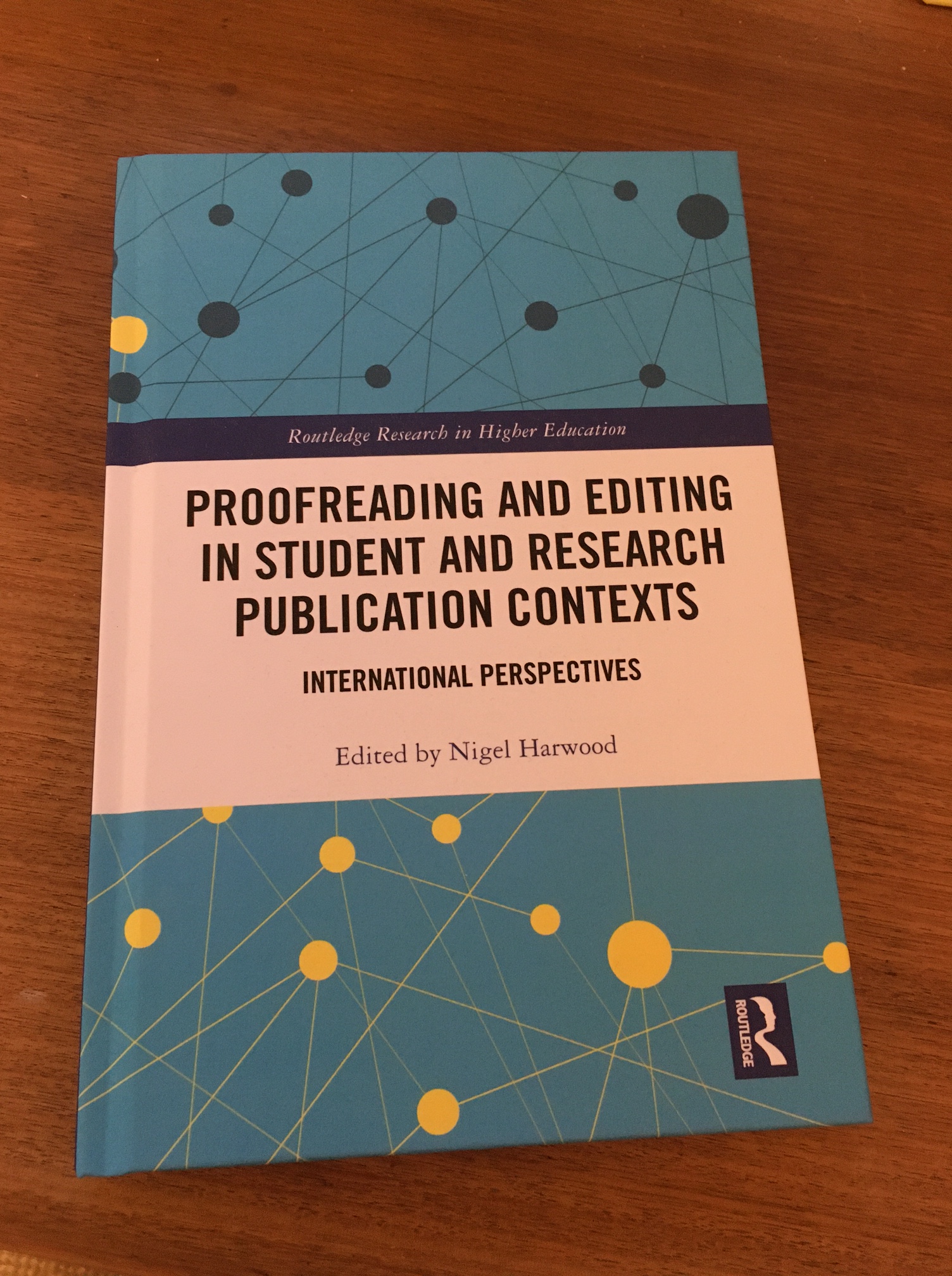
My co-authored chapters in new academic editing book

I am pleased to advise that a book I have co-authored two chapters in, based on my academic editing work, is now available.

The book is Proofreading and Editing in Student and Research Publication Contexts: International Perspectives, edited by Professor Nigel Harwood of the University of Sheffield. It explores proofreading and editing from a variety of research and practitioner-led perspectives to describe and debate roles and policies in the student and research publication context.

My co-author Charlotte Cottier AE and I have been members of IPEd’s Standing Committee on Academic Editing since 2017, noting the chapters reflect our personal views and our experience as self-employed academic editors.

Our two chapters are:

Chapter 4. “Please can you proofread my thesis?” Exploring initial student enquiries for thesis editing in Australia by Charlotte Cottier and Rhonda Daniels

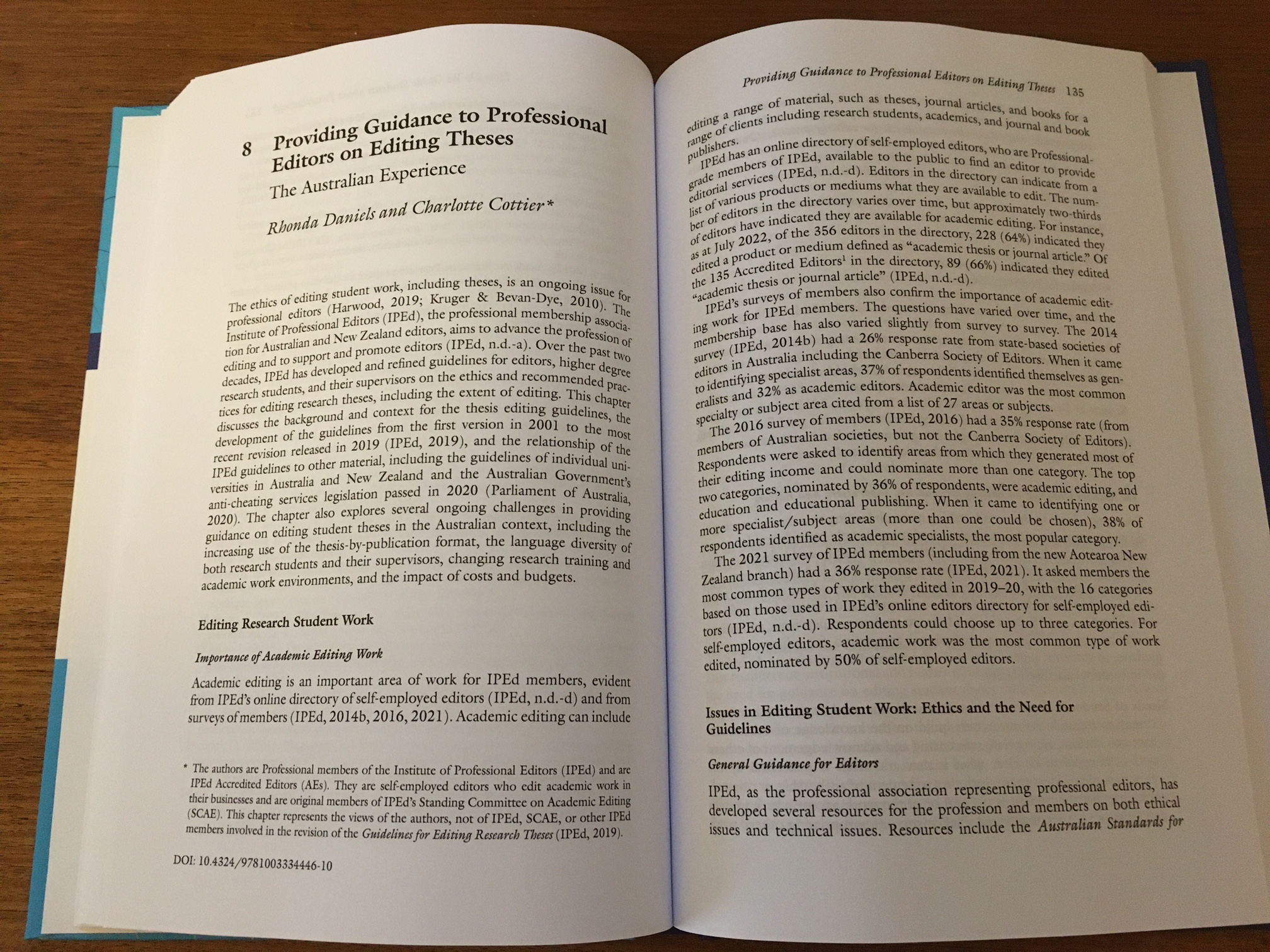
Chapter 8. Providing guidance to professional editors on editing theses: The Australian experience by Rhonda Daniels and Charlotte Cottier

The first page of Chapter 4 titled Please can you proofread my thesis?
The first 2 pages of Chapter 8 titled Providing guidance to professional editors on editing theses

The book was released on 19 March 2024. See the Routledge website here for the table of contents and purchase options:

Discount code to buy the book

As well as the hard copy, an ebook is available at a reduced price. Use this code for a 20% discount: AFLY01

Keeping up with AI tools

In Chapter 8, written in late 2022, a section titled Changing Research Training and Academic Environments refers to increasing use of artificial intelligence in writing. Little did we know of the impact of generative AI tools such as ChatGPT that became publicly available in 2023. As noted in my recent blog, professionals in many fields, including editors, are wondering and worrying about the impact of generative AI and ChatGPT on their working lives. Universities are still developing policy for students.

To work with an accredited editor focused on academic editing, please contact me at rhdaniels@bigpond.com
English as the global language for research

English is increasingly recognised as the global language of research, but this does pose problems for both individual researchers and the broader scientific community.

Ten years ago, in an article in The Conversation in 2013 on English as a world language Stewart Riddle noted: “There are more non-native speakers of English than native speakers; nearly four out of five English-speaking interactions happen between non-native speakers of English; most research is shared in English-language journals; English is the number one language used on internet sites; and most literature is published in English or translated from English into other languages”.

Recently in March 2023, global academic publisher Elsevier commented here on English as the lasting language of publication with an examination of the rise of English as lingua franca of academic publishing.

On a similar theme, in July 2023, Tatsuya Amano from the University of Queensland summarised research in an article in The Conversation: “Our collective emphasis on English places a significant burden on scientists who speak a different first language.” “The scientific community urgently needs to address language barriers so that future generations of non-native English speakers can proudly contribute to science.”

Amano explained the problem: “The use of English in the internationalisation of research and higher education comes at a cost to local knowledge and languages, as academics in … other parts of the world compete with scholars from the UK and USA to publish in high-ranking English-language research journals.”

The dominance of English does impose burdens on individual authors who are not as comfortable writing and communicating in English, and limits the scientific community in general. With journals and conferences receiving so many submissions, sometimes the quality of the English contributes to decisions to reject.

In Australia, with its internationally recognised university sector, there are many academics and research students from English-as-an-another-language backgrounds. Academic editors provide important services for both. Academic editors can be part of the research team, working with individual authors before submission or working with journals.

Read my recent blog on university rankings and academic editing: links for success in Sydney here.

Recognising the issue of language is one step in addressing it. Providing professional assistance can be part of the solution.

To work with an accredited editor who knows academic standards, please contact me at rhdaniels@bigpond.com

Consistency is core for editors and readers

There are many definitions of editing. At its heart, editing is about clear communication and making it easy for the reader. An important way to achieve that is through consistency. Consistency is part of making it easy for the reader by avoiding distractions.

Consistency applies to all aspects of a document from the micro to the macro scale. It includes decisions about the basics of spelling, grammar, punctuation, capitalisation, hyphenation, abbreviations and acronyms, numbers, symbols and common terms. It can refer to sentence and paragraph length and structure which affect the general reading level of a document. It can also refer to the look of a document, from formatting and the heading hierarchy to tables and figures. For documents with sources, consistent use of references both in the text and in the reference list is important and can contribute to the credibility of research work.

Editors and writers make choices about style all the time to meet the needs of their audience and the message. Editing is about decision making, and editors make and implement decisions efficiently and accurately. While there is not always right and wrong in editing, it is important to be consistent within a document.

To ensure consistency and clear communication, there are style manuals and tools for different audiences and purposes. The Australian government’s Style Manual, now available online, has been complemented by other manuals such as the online Australian manual of style. There are guides for the many different styles of referencing, some with minor variations in punctuation. Not everyone will agree there is one accepted right decision. However, using a style guide or style sheet can help ensure consistency throughout a document and over time.

See my blogs on related aspects of consistency:

To work with an accredited editor who strives for consistency and quality, please contact me at rhdaniels@bigpond.com

Reflecting on 2021 as a self-employed academic editor

The second year of the COVID-19 pandemic and a long lockdown in Sydney in the second half of 2021 has been a time of reflection for many on work and work–life balance (and whether working from home helps or not). Editors are used to working efficiently from home offices but there was still a change.

Work life continued in my home office with email inquiries and the occasional more desperate phone call, but without the usual breaks away from the computer. Universities have been affected by COVID and funding reforms, but academics seemed to be even more productive, or have more recognition of the need and value of editing. I edited student theses that were clearly affected by the COVID pandemic in various ways from data collection to challenges to wellbeing. Research continues to be important, and I am pleased to be able to contribute to the dissemination of high quality research.

My ongoing work in voluntary roles on IPEd’s Pay Rates Working Party and Standing Committee on Academic Editing highlighted some important issues in the profession this year. I analysed responses to IPEd’s survey of members which focused on income and working conditions, and wrote a report for members. The survey confirmed the low annual work hours and income of many self-employed editors. I will continue to work to improve the economic status of editors.

As a member of IPEd’s Standing Committee on Academic Editing, it was pleasing to devise and release guidance on indicative costs of academic editing, and a range of other useful resources for academic editors.

We need to raise awareness amongst clients of good practices for an effective relationship and raise awareness amongst professional editors of business practices for a sustainable career.

As part of my professional development, I participated in the online IPEd conference. I renewed my status as an accredited editor, and am a mentor in IPEd’s mentoring program.

2022 brings continued focus on serving my own clients and improving the professional status of editors so we can continue to provide high quality editing for clear communication.

Here’s a recap of my blogs in 2021:

Please contact me for editing inquiries at rhdaniels@bigpond.com

The right scope for editing – the whole thesis or chapter by chapter?

Editors receive many inquiries about the timing and cost of editing. See my previous blog on the right time for editing. For thesis editing, one decision is whether to have the whole thesis edited at once or to have individual chapters edited one at a time.

Whole thesis editing

Whole thesis editing works well when the submission deadline is imminent, the research has been finalised and all the chapters have been assembled into one file. The editor starts at the beginning and edits to ensure consistency and clarity throughout the document. Usually only one round of editing is possible in the timeframe.

Chapter by chapter editing

Chapter by chapter editing works better in the earlier stages when a student may need more guidance on structure and formatting. An editor can provide a style sheet for the student to follow for the rest of the thesis and identify issues for the student to be aware of throughout the other chapters of the thesis. These issues may include document formatting, reference styles or table and figure formats, as well as consistency issues of spelling and references to key concepts. Chapter 1 is usually very short with a standard structure, so is not the most useful for standalone editing. A literature review chapter is a better guide for the rest of the thesis. Chapter editing allows the student to learn and incorporate changes in later chapters.

A thesis in the publication format may also require chapter by chapter editing, as chapters are written individually as articles. Even in this format, the preliminary pages and the overall assembly of chapters into a thesis usually need editing.

Chapter editing is also an option when submission is imminent but limited time or budget is not sufficient to cover whole thesis editing.

Efficiency

Whole thesis editing is usually more time and therefore cost efficient for a given word count because the editor focuses on the whole document, makes decisions and implements them. There is usually repetition of text and therefore of editing changes. Editing a chapter at a time is usually more expensive overall, due to the startup and familiarisation effort each time. IPEd’s indicative costs of academic editing here and discussed in my recent blog reflect this. The 5,000 words at the end of a 100,000 word thesis can be edited faster than the 5,000 words at the beginning. The further apart in time the chapters are edited, the less efficient the process is and more rounds of editing may be required. However, this may provide a better learning experience.

Students must decide based on their own circumstances and discussions with an editor what editing scope is right.

To work with an accredited editor for your academic editing work, please contact me at rhdaniels@bigpond.com