Tag Archives: writing

Top two mistakes in academic writing

The top two mistakes in academic writing I see when editing theses and journal articles are writers trying too hard and not meeting the requirements.

Mistake 1 – Trying too hard

Trying too hard describes a style of writing that tries to impress with complexity, rather than clarity. Impress with simplicity. As much as possible, use the simplest form of a word, delete filler and unnecessary words, keep sentence and paragraph length easy to read, minimise the use of acronyms and jargon, and provide the appropriate level of detail at the right place. Make it easy for the reader. See my other blog tips on writing to impress through simplicity.

Mistake 2 – Not meeting the requirements

As with all writing, academic writing is written for a particular audience for a particular purpose. It is important to know and meet the requirements of the style of writing, the audience and the publisher. Some of the requirements for a thesis might include total word length, original contribution, critical analysis, the structure and the reference style. The requirements for a journal article might include relevance to the aims of the journal, word length, footnotes (or not), and the number of tables or figures allowed.

Improve your academic writing by avoiding the top two mistakes. Keep it clear and simple, and know and meet the requirements.
When are hyphens helpful

A hyphen (-) is a short dash. The Style manual for authors, editors and printers (6th edition, 2002) notes there are few firm rules for the use of hyphens and no simple rights and wrongs. The main advice is to choose one dictionary, such as the Macquarie dictionary, and follow its recommendations. As always in editing, be consistent throughout the document.

Here are some helpful uses of hyphens:

  • Clarify meaning such as re-sign (sign again) versus resign (leave a job).
  • Clarify meaning in compound words such as owner-builder and disease-free.
  • Prevent misreading of words starting with prefixes such as anti, ex and re followed by vowels such as re-enter.
  • Use hyphens in compound adjectives with numbers such as three-part series.
  • Avoid hanging or floating hyphens such as pre- and post-1788.

Hyphens may be used when a word is relatively new, but dropped over time as the word becomes more clearly known and accepted such as email. The use of hyphens also depends on the role of the word in a sentence: consider “in the long term” versus “long-term view”.

My preference is to use one combined word or two separate words, and only hyphenate where required to clarify the meaning.

Don’t confuse hyphens with the main types of (longer) dashes: the em rule and en rule. Hyphens and dashes have different uses. See the next blog for more on dashes.

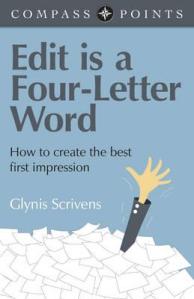
Edit is a four-letter word

compass-points-edit-is-a-four-letter-word

As an editor, the title of this slim volume Edit is a Four-Letter Word by Glynis Scrivens caught my eye on the new book display in my local library. It is a guide for fiction writers on how to edit their own work, but still relevant to all writers.

Here are some messages I liked from the author and other writers in the book:

  • Edit is a four-letter word which requires other four-letter words: hard work, task, slog, pain and time.
  • Editing is all about creating a good first impression.
  • Aim for maximum impact with minimum words.
  • A badly edited piece of work will appear to be poorly written.
  • Language is your tool – use it wisely.
  • 90% of writing is rewriting.
  • Editing will transform your first draft.

For fiction writers, “edit” is the only path to other four-letter words: book deal, sale, cash and fame.

Writers can and should edit their own work and a professional editor can add even more value. See my January 2015 blog on How to edit your own work.

The Style manual – a great resource

The Style manual for authors, editors and printers is published by the Australian Government to provide guidance on preparing material for publication. While originally intended to provide advice for government publications, it is widely used as a reference work for effective communication. 

The current Sixth Edition is a comprehensive reference of over 500 pages with five parts covering:

  • planning the communication
  • writing and editing
  • designing and illustrating
  • legal and compliance aspects of publishing
  • producing and evaluating the product.

Part 2 on writing and editing is the heart of the manual and provides best practice advice on grammar, spelling, punctuation, abbreviations, lists and much more. 

You don’t have to follow every recommendation in the Style manual, but it’s a great starting point to ensure clear and consistent communication.

Some practices have changed since the current edition was published back in 2002. When it is next updated, the new edition is likely to reflect trends towards minimal punctuation and include even more information on electronic publishing. 

The Style manual is only available in hard copy and has a RRP of $44.95. A great resource for all writers and editors.