Category Archives: Editing

Edit is a four-letter word

compass-points-edit-is-a-four-letter-word

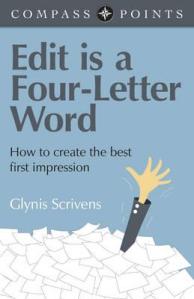
As an editor, the title of this slim volume Edit is a Four-Letter Word by Glynis Scrivens caught my eye on the new book display in my local library. It is a guide for fiction writers on how to edit their own work, but still relevant to all writers.

Here are some messages I liked from the author and other writers in the book:

  • Edit is a four-letter word which requires other four-letter words: hard work, task, slog, pain and time.
  • Editing is all about creating a good first impression.
  • Aim for maximum impact with minimum words.
  • A badly edited piece of work will appear to be poorly written.
  • Language is your tool – use it wisely.
  • 90% of writing is rewriting.
  • Editing will transform your first draft.

For fiction writers, “edit” is the only path to other four-letter words: book deal, sale, cash and fame.

Writers can and should edit their own work and a professional editor can add even more value. See my January 2015 blog on How to edit your own work.

Ensuring graphic design enhances your text

Many authors are responsible for and control all aspects of their document, from the text to the design. But sometimes the text may be passed on to a graphic designer to lay out the document in software such as InDesign to make it look more professional or prepare it for printing.

It is important that the design or layout of the document enhances the text, and does not detract from it. Good design can strengthen the message, while bad design can ruin it.

Elements of design can include choice of fonts for text and headings, white space, colours, design of non-text elements such as tables, figures and diagrams, and size and placement of non-text elements. The design should enhance the text and help communicate the message to the audience.

Here’s how to ensure your text is enhanced by document design:

  • Finalise the text and structure before it goes to the designer.
  • Brief the designer on the audience and message of the document.
  • Do a test design and revise if required.
  • Check all non-text elements, such as diagrams, illustrations and photographs, carefully.
  • Allow sufficient time to check all elements of the designed document.

As well as editing text, editors can also review the design of a document for consistency and clear communication, and provide advice on all document elements.

100%, 100 per cent or 100 percent?

A perfect score of 100 is great – but is that written 100%, 100 per cent or 100 percent? I’m all for 100%.

The Style manual for authors, editors and printers (Sixth edition, 2002) noted that the spaced form of per cent is the most commonly used in Australia, but percent is the dominant form in the United States.

Using the % symbol with numerals, particularly in statistically oriented text such as reporting survey results, makes the numbers stand out and makes it easier to compare numbers. The % symbol should always be used in tables.

The Style manual supports this use: “Where numerals are generally being employed for numbers, it is preferable also to show percentages in numerals with the symbol”.

The words per cent or percent are still used as an unnecessary sign of more formal writing, but let’s change that. As always in editing, the aim is to communicate clearly and make it easy for readers to understand the text and the numbers.

So it is not wrong to use the % symbol. But be consistent: don’t use 100 per cent in half your document and 100% in the other half.

In relation to pertaining to – don’t!

The only place to use the two phrases “in relation to” and “pertaining to” is an article about not using them. In most cases, these phrases can be replaced with simpler words such as ”about”, “for”, “on” or “in”.

Keep your writing clear and simple to allow readers to focus on your key messages. Unnecessary words and phrases just make it more difficult to focus on the important words.

Next time you read text with either of these two phrases, replace the phrase with “about” or delete it and see if the meaning changes. Avoiding “in relation to” and “pertaining to” makes the text clearer.

How to check your own reference list

When editing academic work such as theses, journal articles and reports, I always check that all the references in the text are in the reference list, and all the references in the reference list are used in the text.

Referencing is important because it allows readers to find, read and check the original sources you found useful. Accuracy in referencing contributes to the credibility of your work.

Here’s how I do it.

  • Print a hard copy of the reference list.
  • Start at the beginning of the document file and scroll through it onscreen.
  • For every reference, tick it off on the hard copy reference list.
  • Check the spelling of the author and the date are the same in the text and the list.
  • If the reference is not in the list, write the author and date on the list.

At the end, you should have a reference list with hopefully all (or most) references ticked off, and no extra references to add.

  • Check errors are not due to poor spelling or incorrect dates.
  • Add in references which are missing.
  • Use the “find” feature to check references do not appear in the text, before deleting references not used.

Referencing software such as Endnote can help keep track, but it is still worth a final manual check. Formatting the reference list consistently with complete information is also important.

Short summaries take time

The summary at the beginning of a longer document is intended to save readers time by summarising the whole document. The summary may be called an abstract for a journal article, or an Executive Summary in a report.

It can be a challenge for authors to condense all their careful thought and effort on a long document into a much shorter summary. But remember the reader.

More people will read the summary than the whole document. Ideally the summary will encourage readers to read on. But if they don’t, what do you want people to know and remember?

It can take a surprising amount of time to get the summary right as every word is carefully considered. If time is limited, copying sentences from the document is a starting point, but it is best to write just for the summary.

Tips

  • Be aware of any length limits, such as 100 words or one page.
  • Allow enough time to write the summary – don’t rush it at the last minute.
  • Rewrite key messages in a clear and succinct form.
  • Choose words carefully to convey the extent of certainty.
  • Focus on the results, more than the process, if space is limited.
  • Remember a well-chosen graphic or key statistic may be more effective than many words.
  • Use the present or past tense (not the future tense), as the work has been done.

See our related post on writing to a word limit (August 2014).

Choosing the right word

The words you choose to describe important content and issues in your document can set the tone for your document, and influence the reaction of your readers. Choosing the right word can make all the difference to your document.  Take special care with words in titles. If the title doesn’t have the right words, or is unclear, confusing or offensive, some readers may not read on.

Consider these examples:

  • Are people described as clients, customers, consumers or stakeholders?
  • Are older people described as seniors, the elderly, the aged, pensioners or retirees?
  • Are women described as ladies, girls, females or women?
  • Are people who walk described as vulnerable road users, pedestrians or active transport users?

Language is always changing, so be aware of changing trends in meanings and preferred terms. Large organisations may have a style guide to provide guidance. An editor can advise whether the words you have used are the best for your document and audience, or may be inappropriate.

For more, see our March 2014 post on inclusive language – be inclusive by using gender-neutral or gender-free language.

Impress with simplicity

Right with Rhonda helps you impress the people you need to impress with words. But you don’t need to use long words, long phrases or long sentences to impress people. To communicate clearly, use the shortest form of a word and use a verb not a noun phrase.

For example, use

  • in, not within
  • use, not utilise
  • start, not commence
  • investigate, not conduct an investigation
  • evaluate, not undertake an evaluation.

Ask yourself: do the extra letters and words add to the meaning or not? If the extra words are not needed, delete them. Of course, sometimes a longer word or phrase is needed to clearly convey a specific meaning. As much as possible, keep it simple and short.

Acronyms are awful

Acronyms and initialisms are strings of capital letters without full stops used to shorten long organisation names or groups of words such as ABS for Australian Bureau of Statistics, NSW for New South Wales, or CPI for consumer price index. Acronyms are easy for the writer but hard for the reader, so try to avoid using them.

Acronyms save the writer from typing out long names and phrases in full and make the text look shorter. But a paragraph, page or document full of acronyms is hard for the reader, who may be less familiar with all the terms used, and over-use of acronyms can slow a reader down.

Tips

  • Use acronyms only for very well known organisation names or the author or publisher of the document
  • Write out as many acronyms as possible in full, especially if they are only used a few times
  • Include a glossary or list of acronyms at the front of the document if use is unavoidable
  • Use acronyms in tables where space is more limited, but include a note to explain the term.

These tips also apply to abbreviations and contractions. Make it easy for the reader.

Getting it right through fact checking

I’ve been reading The Fact Checker’s Bible: A Guide to Getting it Right by Sarah Harrison Smith, a former fact checker at The New Yorker, which is a great resource on the importance and process of fact checking. Getting facts right can prevent embarrassment, enhance credibility, save money by preventing lawsuits, and identify plagiarism.

The Fact Checker’s Bible discusses checking a wide range of facts including names, dates, biographical details, locations, descriptions, quotations, lyrics, maps and artwork – in fact, everything in a story or article.

The role of editors in fact checking work depends on the specific requirements of the job, and often the time and budget available. Editors may check all facts, some or none. Every fact can be checked or only the most controversial.

Tips for writers

  • Keep records of your sources and notes.
  • Try to check facts yourself.
  • Critically evaluate sources and check with experts.

Tips for editors

  • Be aware of facts that may need to be checked.
  • Ask the author for their sources and notes.
  • Ensure non-text material such as maps, photos and artwork is consistent with the text.
  • Check headings, headlines and captions where errors may be more visible than in the text.
  • Identify material which has not been checked.
  • Don’t assume someone else has checked it.

But what is right? A sobering line in the book is: “It is ironic that many of the best resources for fact checkers are not fact-checked to the standard to which checkers aspire”.

For more, see my April 2014 post on right and wrong in editing.